Reverse Auction Software on AuctionWorx
AuctionWorx is a forward-auction platform. This page explains what maps to procurement and what would be a custom build.
15+ years on AuctionWorx · RainWorx Premium Partner
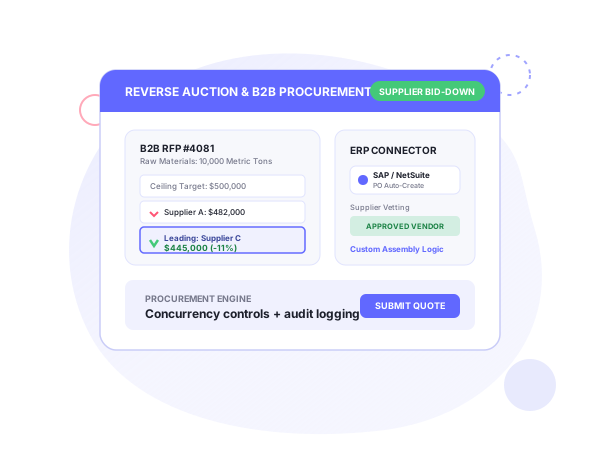
In a reverse auction a buyer posts what they need and suppliers bid the price down. AuctionWorx doesn’t ship as reverse auction software out of the box. This page maps the nearest existing pieces and marks what would be built.
Forward vs reverse
AuctionWorx bids run upward. Enterprise handles listings that close independently, and Events handles cataloged sales with staggered closing. Both have proxy bidding, reserve pricing, buy-now, auto-extend and integrated invoicing.
For procurement, what carries over is the platform around the bidding: accounts, notifications, invoicing, hosting and integrations. The lowest-price-wins model is a custom bidding model. Systenics’ customization guide covers custom bidding engines in general, with Dutch, make-an-offer and sealed-bid examples.
Sealed-bid and tender flows
An RFQ often runs sealed: suppliers submit a price by a deadline, nobody sees the others, and the buyer opens them together. Systenics’ customization guide describes sealed-bid and tender functionality that keeps submissions encrypted in the database until the closing time. It is a custom build.
Dutch vs true reverse bidding
The Dutch auction engine starts a price high and drops it at set intervals, down to a floor price, until a buyer accepts. That is a seller lowering its own asking price. Reverse bidding is suppliers lowering offers to win one buyer’s business. The Dutch engine doesn’t do that.
Its scheduling (date ranges, time windows, recurrence and reusable templates) is what you would borrow. The bid logic would be new. The customization guide warns that this kind of engine needs concurrency controls to stop duplicate purchases when several bidders act at once.
Volume Buy tier pricing is a forward wholesale mechanic. A seller sets minimum and maximum quantities per tier and a unit price for each. It fits supplier-side catalogs, not a buyer’s RFQ.
Supplier access
Enterprise edition can run an approved multi-seller marketplace where vetted vendors list goods, per Systenics’ edition comparison. Systenics also lists gated listing access for verified members and two-factor authentication for the admin control panel. Single sign-on with a corporate identity provider is not something Systenics documents, so treat it as custom work.
ERP and CRM
Systenics’ development page names HubSpot and Salesforce, and its development services list custom ERP among third-party integrations. Our integrations page describes how that work is done.
Hosting
Systenics recommends Microsoft Azure for hosting AuctionWorx and its hosting article lists data backup and recovery and geo-redundancy. Our hosting and support page is the service side of that.
How a reverse-auction build runs
Custom work follows four steps. A free discovery call produces a ballpark estimate. Requirements and UI/UX mockups tighten it. The build runs in milestones, is deployed to your AuctionWorx installation and supported through later updates. Systenics builds custom bidding models in separate assemblies, so the next AuctionWorx release doesn’t overwrite them.
Configure vs customize
| Need | Existing capability | Custom development |
|---|---|---|
| Forward auctions and invoicing | Both editions | No |
| Descending-price selling | Dutch auction engine | No |
| Tiered wholesale pricing | Volume Buy | No |
| Supplier bid-down | Not available | Yes |
| Sealed bids until deadline | Not available | Yes |
| CRM, ERP, single sign-on | Not stock | Yes, as integration work |
Frequently asked questions
Ready to build on AuctionWorx?
Book a call or send us your project details, and we'll get back to you with next steps.
